
Meat & Poultry Industry
Home > Industries > Meat & Poultry
Clayton Industries Supports the Meat & Poultry Industry
Meat and Poultry is a specialized subset of the Food and Beverage industry, and the tremendous need to cook, smoke, and sanitize products in this industry headlines the need for steam. Throughout the entire process, steam plays a vital role in this industry. With the large increase in consumption of poultry products and the increase in per capital consumption of chicken it is vital the potential hazards from salmonella be dealt with and eliminated. Salmonellae can be introduced in eviscerated poultry from infected breeder flocks, and so Steam is used to scald carcasses.
With the large increase of poultry products and the growing consumption of chicken, it’s vital that any potential hazards be eliminated from the outset. Steam plays a critical role in the elimination of salmonellae and other contaminants through a process known as scalding. Steam continues to be used throughout the process to prevent surface bacteria from collecting on meat, typically done through means of steam chambers that hit poultry and meat pieces with short blasts of steam.
Steam also plays a role in industrial smoke houses, where precise temperature and humidification control is essential to assuring product quality and food safety, as well as being a key component in rendering. Additionally, steam is used to keep surfaces throughout the facility clean and sanitized, ensure product quality and safety, while keeping production moving forward.
Look to Clayton Steam Generators for high quality steam, constant pressure and temperature control, and a fully factory trained team to support your preventive and emergency maintenance needs.

Key Benefits
Precision Control
Whatever it is that you’re making, Clayton can provide you with a reliable and steady source of steam, guaranteed to meet the levels of moisture, temperature, and pressure that your application requires.
Compact Design
Save on the floor space with Clayton’s minimalist design, which takes up less than on third of the floor space compared to a traditional firetube boiler.
Inherent Safety
Clayton’s design completely eliminates the possibility of a catastrophic steam explosion, protecting your facility, your product, and most important of all, your employees.
Rapid Response
Clayton Steam Generators are able to handle your swings in production, able to rise and fall to meet your changing demands, without sacrificing steam quality.
Featured Case Study
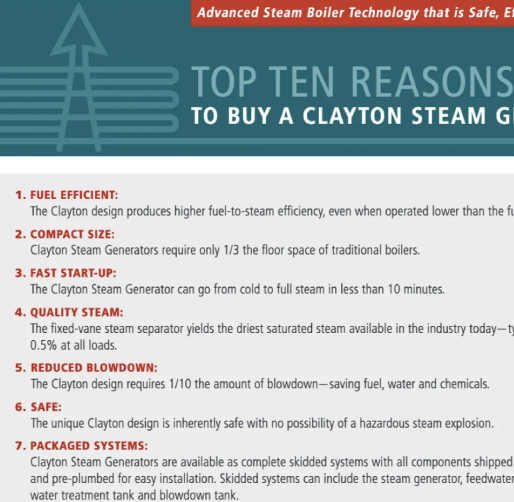
Top 10 Reasons To Buy a Clayton Steam Generator
1. FUEL EFFICIENT:
The Clayton design produces higher fuel-to-steam efficiency, even when operated lower than the full firing rate.
2. COMPACT SIZE:
Clayton Steam Generators require only 1/3 the floor space of traditional boilers.
3. FAST START-UP:
The Clayton Steam Generator can go from cold to full steam in less than 10 minutes.
4. QUALITY STEAM:
The fixed-vane steam separator yields the driest saturated steam available in the industry today — typically less then
0.5% at all loads.
Frequently Asked Question's
Steam boilers provide heat for cooking, scalding, rendering, and cleaning operations. They also supply steam for humidity control in industrial smokehouses. A plant’s requirements depend on its products, processing equipment, and production schedule.
Steam helps control humidity alongside temperature during smokehouse processing. These conditions influence how the product heats and the quality of the finished meat. The steam supply must work with the smokehouse controls to maintain the conditions specified for each production cycle.
Yes, when the steam system is suitable for direct food contact. Steam purity must be assessed through feedwater treatment, generation, distribution, and point-of-use controls. Ordinary plant steam should not be assumed suitable simply because it is hot or appears clean.
Plant steam is the general utility steam produced by a boiler. Culinary steam typically undergoes additional preparation, including filtration and moisture separation, for food-contact applications. Filtration removes particles but does not address every possible chemical contaminant, so treatment and monitoring remain important.
Boiler capacity should reflect the highest realistic simultaneous demand from cooking equipment, smokehouses, rendering systems, and sanitation services. Include startup peaks, distribution losses, and planned expansion. Review lower-demand periods as well, so the system can operate effectively between batches and production shifts.
Required pressure varies by equipment and process. Confirm each machine’s steam inlet pressure, flow rate, and operating conditions with its manufacturer. Account for distribution losses when specifying the boiler, and provide suitable pressure controls where different processing areas require different supply conditions.
Yes, provided the system is sized for the overlapping loads. Cleaning operations can add substantial demand while cooking or other processing equipment remains active. Include sanitation schedules in the load assessment rather than sizing the boiler around production equipment alone.
Stable steam conditions help equipment deliver predictable heat. Excess moisture can affect heating performance, while contamination is a separate concern wherever steam contacts food. Specify both the physical steam conditions and the purity needed for each application, rather than treating dryness as proof of cleanliness.
Yes, when its capacity and controls match the plant’s operating pattern. Starting cooking equipment or switching production stages can create rapid changes in steam demand. Clayton identifies response to changing loads as a key feature of its meat and poultry steam systems.
Repair leaks, maintain steam traps, insulate steam piping, and keep the boiler properly tuned. Recover suitable condensate and assess practical heat-recovery opportunities. Reviewing the complete system helps identify losses across both processing and sanitation, rather than focusing only on boiler efficiency.

Contact a Clayton Representative