
Non-Manufacturing Industry
Home > Industries > Non-Manufacturing
Clayton Industries Supports the Non-Manufacturing Industry
While steam is widely used in the manufacture of goods and materials, there are a wide range of other uses for steam that are common, but perhaps less well known. Some of Clayton’s customers are using stream to keep art galleries at ideal humidity levels, break winter ice in their city’s rivers, or power a good old fashion heritage steam locomotive. You’ll even find one in Jay Leno’s garage next to his exotic cars, where he powers an antique steam engine. No matter your industry, Clayton can provide a source for steam even if your application falls outside of established industry practice.
High pressure, or superheated steam, which is steam without moisture, is an ideal medium for industrial and mechanical work of all kinds, from turbines to simple rotational output shafts. Its use as a natural humidifier makes it well suited to adjusting the moisture levels in the air, creating ideal settings for specialized work, as well as creating a more comfortable indoor space for its occupants. Steam is also still used as a heating source, flowing through piping systems for use in radiators or convectors, warming residential, industrial, or commercial buildings.
Another application is clean steam, a sterile, safe steam that can be used to sterilize and clean items in a cleanroom or any other setting with strict cleanliness criteria. Clean steam is ideal for higher levels of steam sterilization and humidification. This is normally accomplished with a steam to steam generator. Pure steam is mainly used for sterilizing tanks, filters and piping systems, as well as products in sterilizers. Moreover, it is used for air-moistening in cleanroom systems.
Whatever your application, Clayton Steam Generators feature a compact size, quick start up, and industry leading reliability, making them the best solution to your steam needs, regardless of your industry.

Key Benefits
Compact Size
Clayton’s products perform better than the rest, all in smaller size. Cour compact steam generators take up less than a third of the floor space when compared to a traditional firetube, freeing up more room for your application.
Rapid Response
Regardless of your steam needs, Clayton is stand by under any circumstance, able to ramp up and tamper off to meet your rising and falling steam demands, all without sacrificing quality.
Precise Control
Whatever your need, Clayton’s industry leading control setup provides you with exact levels of moisture, temperature, or pressure that your application requires.
Lowest Cost of Ownership
Clayton’s efficient design is guaranteed to lower your fuel bill and your operational costs, freeing up your finances.
Featured Case Study
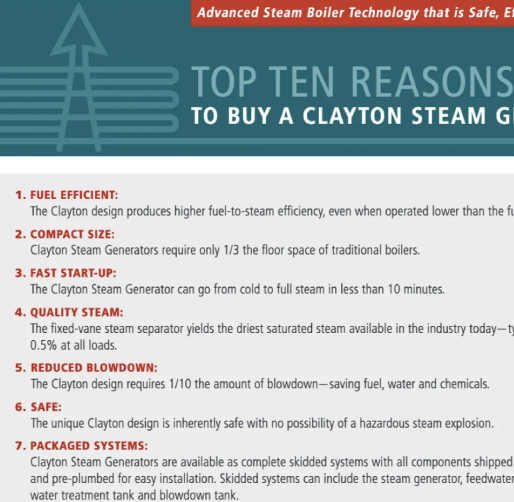
Top 10 Reasons To Buy a Clayton Steam Generator
1. FUEL EFFICIENT:
The Clayton design produces higher fuel-to-steam efficiency, even when operated lower than the full firing rate.
2. COMPACT SIZE:
Clayton Steam Generators require only 1/3 the floor space of traditional boilers.
3. FAST START-UP:
The Clayton Steam Generator can go from cold to full steam in less than 10 minutes.
4. QUALITY STEAM:
The fixed-vane steam separator yields the driest saturated steam available in the industry today — typically less then
0.5% at all loads.
Frequently Asked Question's
Steam boilers serve building heating, humidification, cleaning, and specialized mechanical applications. Clayton highlights examples including art-gallery humidity control, ice removal, and heritage steam equipment. The appropriate system depends on the application’s steam pressure, flow, and quality requirements.
Yes. Steam can supply moisture through a suitable humidification system to help maintain the indoor conditions required by a collection. Clayton identifies art-gallery humidification as an application. Humidity targets and controls should be specified for the building and its contents rather than using one universal setting.
Yes. Steam can distribute heat to radiators, convectors, or heat exchangers serving a building’s heating system. Boiler selection should account for the existing distribution network, seasonal demand, and operating schedule, as well as any other equipment drawing steam from the same supply.
Saturated steam is at the boiling temperature corresponding to its pressure. Superheated steam has been heated above that temperature at the same pressure. Saturated steam is commonly used for heat transfer, while superheated steam suits certain mechanical and specialized duties. High-pressure steam is not automatically superheated.
A separate clean steam generator may be needed when the application requires tighter control of contaminants than the plant steam supply can provide. Some sterilization and controlled-environment applications have these requirements. Selection should follow the equipment’s specified steam purity and quality, not dryness alone.
A steam-to-steam generator uses plant steam as its heat source to boil a separate feedwater supply. A heat-transfer surface keeps the two circuits apart. With suitable feedwater, materials, and controls, this arrangement can produce clean steam without using the plant steam directly in the sensitive application.
Define the required pressure, temperature, flow rate, and duration of each operating cycle. Separate startup demand from steady operation and identify which loads overlap. This helps select a system that can meet short peaks without being unnecessarily oversized for normal use.
Yes, where the application allows the system to shut down between uses. Clayton lists startup to full steam in under ten minutes on this page. Confirm performance for the selected configuration and allow additional time for downstream piping and equipment to reach operating conditions.
Provide the application, required steam conditions, minimum and peak demand, and operating schedule. Include available utilities, feedwater analysis, installation space, and any backup requirements. For specialized equipment, share its technical specifications so the proposed system can be assessed against the actual duty.
Repair leaks, maintain steam traps, insulate distribution piping, and keep the boiler properly tuned. Recover suitable condensate and review opportunities to reduce unnecessary cycling or standby operation. Assessing the complete system helps identify losses between steam generation and its final use.
Contact a Clayton Representative